
Going through a divorce is never easy. When you’re an expatriate living in Belgium, the process becomes significantly more complex – involving multiple legal systems, languages, and cross-border considerations that most divorce lawyers rarely encounter.
Whether you’re a British, American, or other international professional based in Brussels, Antwerp, or elsewhere in Belgium, this guide will walk you through everything you need to know about international divorce proceedings: from Belgian divorce law and jurisdiction rules, to property division across borders, spousal maintenance, and child custody arrangements.
With 29 years of experience helping expatriates navigate cross-border divorce in Belgium, I’ve compiled the most critical information, practical tips, and answers to the questions my clients ask most frequently.
➤ Need immediate advice? Book an initial consultation to discuss your situation: info@avocat-vdb.be

Belgian divorce law is governed by the former Civil Code (ancien Code civil), which establishes two primary grounds for divorce: the irretrievable breakdown of the marriage and mutual consent of both spouses. The ground you choose will determine the procedure, timeline, and requirements of your divorce.
One of the most important things for expatriates to understand is that Belgium no longer recognises fault-based divorce. The Law of 27 April 2007 (in force since 1 September 2007) fundamentally reformed Belgian divorce law. The former grounds for divorce – adultery, cruelty, serious insults – were entirely abolished as independent causes of divorce.
This means that a spouse seeking divorce in Belgium does not need to prove any fault on the part of the other spouse. The sole ground for a contested divorce is now the irretrievable breakdown of the marriage (désunion irrémédiable). For expatriates coming from legal systems where fault still plays a central role (such as certain US states or many non-European countries), this is a significant difference.
Article 229 §1 of the former Civil Code (ancien Code civil) defines irretrievable breakdown as follows: the breakdown is irretrievable when it “makes the continuation of the life together and its resumption between the spouses reasonably impossible.”
In practice, this can be established in two ways:
💡 What this means for you: No matter the circumstances of your marriage, you have the right to obtain a divorce in Belgium. You do not need your spouse’s agreement, and you do not need to prove they did anything wrong. The law guarantees access to divorce for everyone.
Before initiating divorce proceedings in Belgium, the following conditions must be met:

For expatriates, one of the most critical – and often overlooked – questions is: which country has jurisdiction over your divorce?
Within the European Union, jurisdiction is primarily determined by the Brussels IIb Regulation (Council Regulation (EU) 2019/1111, which replaced the earlier Brussels IIa Regulation in August 2022). This regulation governs jurisdiction for divorce, parental responsibility, and international child abduction across all EU Member States.
The key jurisdictional criteria include: the habitual residence of the spouses, the last common habitual residence (if one spouse still lives there), and the nationality of both spouses. In practice, if you and your spouse both reside in Belgium, or if Belgium was your last shared residence, Belgian courts will typically have jurisdiction. However, if one spouse has returned to their home country, multiple jurisdictions may be competent – and the first court where proceedings are filed generally takes precedence. This is called the lis pendens rule (from Latin, meaning “a case pending”): once proceedings are initiated in one country, courts in other countries must decline jurisdiction.
💡 Important for non-EU nationals: The Brussels IIb Regulation and the other EU regulations mentioned in this guide apply in the courts of participating EU Member States regardless of the nationality of the spouses. Whether you are American, British, Japanese, or of any other nationality, if your case falls within the jurisdiction of a Belgian court, these EU rules will apply. Furthermore, these regulations may designate the law of a non-EU country as the applicable law. In other words, you do not need to be an EU citizen for these regulations to affect your divorce.
⚠️ Important: In cross-border divorces, acting quickly to file in the most favourable jurisdiction can significantly impact the outcome. This is known as the “race to court.” Seek legal advice as early as possible.
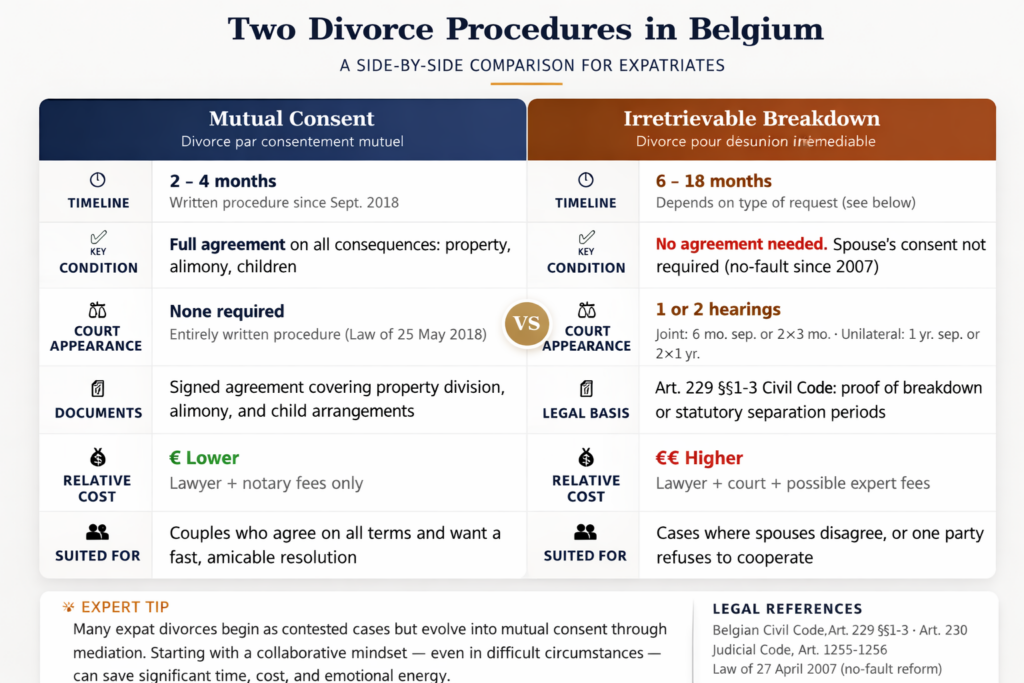
This is the most straightforward and cost-effective option. Both spouses must agree on the divorce itself and on all its consequences: property division, spousal maintenance, and child custody arrangements.
The spouses prepare a comprehensive agreement (convention préalable) with the help of their lawyers or a notary. Since the law of 25 May 2018 (effective 1 September 2018), the procedure is in principle entirely written – personal appearance before the court is no longer mandatory. The judge may still order the parties to appear in exceptional circumstances, for example when the agreements may not adequately protect the children’s interests. The entire process generally takes two to four months.
When spouses cannot reach a full agreement, either party may petition for divorce based on the irretrievable breakdown of the marriage. This can be proven through:
This procedure requires at least two court appearances. The legal timeframe is strictly defined: for a joint request, the divorce can be pronounced after more than 6 months of de facto separation, or after two hearings spaced 3 months apart. For a unilateral request, the divorce is pronounced after more than 1 year of de facto separation, or after two hearings spaced 1 year apart (Article 229 §§2-3 of the former Civil Code). In practice, the entire process typically takes between 6 and 18 months.

Asset division is often the most complex and contentious aspect of an international divorce. The outcome depends largely on the matrimonial property regime that applies to your marriage.
For international couples, determining which law governs the matrimonial property regime is a critical and often complex question. In Belgium, the answer depends heavily on when your marriage was celebrated:
Marriages before 1 October 2004 (before the Belgian Code of Private International Law, known as the CODIP – Code de droit international privé):
The former rules of private international law apply. In the absence of a choice by the spouses, the applicable law is determined by the common nationality of the spouses at the time of the marriage. If the spouses had different nationalities, the law of their first marital domicile applies. This distinction is still relevant today for the many expatriates who married before 2004.
Marriages between 1 October 2004 and 28 January 2019 (Belgian Code of Private International Law – CODIP, Article 51):
The Belgian Code of Private International Law introduced a new hierarchy of connecting factors. In the absence of a choice of law by the spouses, the applicable law is: (1) the law of the State where both spouses established their first habitual residence after the marriage; failing that, (2) the law of their common nationality at the time of the marriage; failing that, (3) the law of the State where the marriage was celebrated.
Marriages from 29 January 2019 onwards (EU Matrimonial Property Regulation – Council Regulation (EU) 2016/1103):
The EU Matrimonial Property Regulation provides uniform rules across 18 participating Member States, including Belgium. Importantly, this regulation has universal application: it applies regardless of the nationality of the spouses, and it may designate the law of a non-EU country as the applicable law. In the absence of a choice, the applicable law is determined by: (1) the first common habitual residence of the spouses after the marriage; failing that, (2) their common nationality at the time of the marriage; failing that, (3) the law of the State with which the spouses jointly have the closest connection at the time of the marriage.
⚠️ Important: Under all three regimes, spouses may choose the applicable law, subject to certain conditions. However, a choice made before 2004 may be subject to different validity requirements than one made under the CODIP or the EU Regulation. I strongly recommend consulting a specialist before making any assumptions about which law governs your property.
Expatriates commonly face additional challenges including: assets held in multiple countries, real estate subject to different national laws, pension rights across jurisdictions, stock options or corporate benefits governed by foreign employment law, and currency conversion issues. Professional valuation and cross-border legal coordination are essential.
➤ Dealing with assets in multiple countries? I work closely with international notaries and tax advisors to ensure comprehensive asset division. Contact me for tailored advice: info@avocat-vdb.be
As long as the divorce has not been pronounced, the mutual duty of support between spouses remains in force – even during a de facto separation. This means that the court may order one spouse to pay a provisional maintenance allowance to the other during the divorce proceedings.
The essential criterion is the maintenance of the same standard of living as before the separation. According to the Belgian Court of Cassation (Cour de cassation), the amount of the provisional allowance must provide the recipient with a level of resources sufficient to maintain the standard of living that would have been theirs had there been no separation, taking into account their own resources. However, this does not mean that each spouse must have equal income – it does not require an equal split of earnings.
The duty of support may also take other forms, such as the exclusive use of the former marital home, the obligation to continue paying the mortgage, or a combination of payments in cash and in kind. The court may also require the recipient spouse to take reasonable steps to generate their own income, even if they were not working during the marriage.
After the divorce is finalised, the situation is fundamentally different. Post-divorce alimony is not based on maintaining the same standard of living. It may only be awarded if one spouse is in a state of financial need (état de besoin) and the other has sufficient means. The amount must cover the applicant’s needs, not their former lifestyle. Key rules include:

Child custody is often the most emotionally charged issue in a cross-border divorce. Belgian law strongly favours joint custody (autorité parentale conjointe), based on the principle that maintaining a close relationship with both parents serves the child’s best interests.
Under joint parental authority (autorité parentale conjointe), both parents share decision-making authority regarding the child’s education, health, and welfare. This is the default rule in Belgian law, even after divorce. Sole parental authority is only granted in exceptional circumstances, such as domestic violence, parental incapacity, or situations where joint authority would harm the child.
An important distinction must be made between parental authority (who makes decisions about the child) and residence arrangements (where the child lives). Even when parental authority is shared jointly, the child’s residence may be organised in different ways.
The Law of 18 July 2006 introduced Article 374 §2 of the former Civil Code. When parents cannot agree on residence arrangements, the court must examine as a priority the possibility of equal residence (hébergement égalitaire) between both parents. However, two essential conditions must be understood:
First, this priority examination only arises if at least one parent specifically requests it. The court does not impose equal residence of its own motion. If neither parent asks for it, the judge is not required to examine this option first.
Second, the 2006 law brought about an important reversal of the burden of proof. Before the reform, the parent requesting equal residence had to demonstrate why it was in the child’s interest. Since the reform, it is the parent who opposes equal residence who must prove the existence of serious counter-indications showing that this arrangement would not be appropriate. This is significant: if the opposing parent fails to demonstrate valid grounds, equal residence is likely to be ordered.
That said, equal residence is by no means automatic. Article 374 §2 of the former Civil Code expressly states that if the court considers that equal residence is not the most appropriate formula, it may order a different arrangement. The court must issue a specially reasoned judgment, taking into account the concrete circumstances of the case and the interests of both the children and the parents.
The parliamentary preparatory works cite the following factors (non-exhaustive list) that may justify departing from equal residence:
The court with jurisdiction over custody matters is generally the court of the child’s habitual residence. Within the EU, the Brussels IIb Regulation (Council Regulation (EU) 2019/1111 on jurisdiction, recognition, and enforcement of decisions in matrimonial matters and parental responsibility) governs these questions. If the child lives in Belgium at the time of separation, Belgian courts will decide. However, if one parent relocates with the child to another country, complex issues of international child abduction (governed by the 1980 Hague Convention on the Civil Aspects of International Child Abduction) may arise.
⚠️ Critical warning: Relocating with your child to another country without the other parent’s consent or a court order may constitute international child abduction, with serious legal consequences. Always seek legal advice before any relocation.
Child support in Belgium covers the financial contribution towards the child’s maintenance, education, healthcare, and development. It is owed until the child reaches adulthood (18) or completes their education. The amount is determined based on the income of both parents, the child’s needs, and the custody arrangement in place.
Access rights ensure that the non-custodial parent maintains a personal relationship with the child through regular visits and communication. The court may also grant access rights to other family members, such as grandparents, when this serves the child’s best interests.
For expatriates, enforcing child support orders across borders and managing practicalities like travel costs between countries are common challenges. The 2007 Hague Convention on Child Support and the EU Maintenance Regulation provide frameworks for cross-border enforcement.

If you obtained a divorce abroad and now live in Belgium – or if your Belgian divorce needs to be recognised in another country – understanding the recognition process is essential.
Within the EU, divorce judgments from other Member States are generally recognised automatically under the Brussels IIb Regulation. For divorces granted outside the EU, recognition must be requested through Belgian administrative authorities or courts, and the foreign judgment will be reviewed for compliance with Belgian public policy and procedural standards.
Key documents typically required include: the original divorce judgment (with apostille or legalisation), a certified translation into French, Dutch, or German, and proof of service on both parties. Processing times can vary from a few weeks to several months depending on the complexity of the case.
 Choose a lawyer with specific expertise in international family law, not just Belgian domestic divorce.
A mutual consent divorce typically takes two to four months. Since 1 September 2018, the procedure is in principle entirely written, with no mandatory court appearance. A divorce based on irretrievable breakdown takes between 6 and 18 months, depending on the type of request: a joint request requires either 6 months of de facto separation or two hearings 3 months apart; a unilateral request requires either 1 year of de facto separation or two hearings 1 year apart. These are legal maximums – the judge must pronounce the divorce once the statutory periods have elapsed.
Yes, in many cases. If Belgium was your last shared habitual residence and you still live here, Belgian courts generally have jurisdiction. However, your spouse may also file in their country of residence, so acting promptly is important.
Post-divorce alimony in Belgium cannot exceed one-third of the paying spouse’s net income. The court considers multiple factors including the standard of living during the marriage, the duration of the marriage, and each spouse’s financial situation.
EU divorce judgments are generally recognised automatically. Non-EU divorces require a formal recognition procedure through Belgian authorities. The judgment must comply with Belgian public policy and basic procedural guarantees.
Belgian courts strongly prefer joint custody. The court of the child’s habitual residence has jurisdiction. Decisions are based on the child’s best interests, including their preferences (if old enough), the parents’ capabilities, and the stability of the proposed arrangements.
While not legally mandatory for all procedures, having a Belgian lawyer with international family law expertise is strongly recommended. Cross-border divorces involve complex jurisdictional, financial, and child-related issues that require specialised knowledge.

International divorce in Belgium is complex, but you don’t have to face it alone. As the founder of this practice, with 29 years of experience in international family law, I have personally guided hundreds of expatriates through cross-border divorce proceedings – from initial strategy to final resolution.
I advise on jurisdiction and applicable law, property division across multiple countries, spousal maintenance and child support, custody arrangements and relocation issues, and recognition of foreign judgments. I also represent clients before Belgian family courts and work with an international legal network to protect your interests abroad.
➤ Book your initial consultation today.